

Listen to the AI-generated audio version of this article. (Beta)
There’s an email you haven’t opened for four days. You roughly know what it says, and that’s exactly why you leave it unread. Every time your eye passes over the subject line something tightens. You click away, quickly do something else, and in the second the email is out of sight, things get better. That’s the catch.
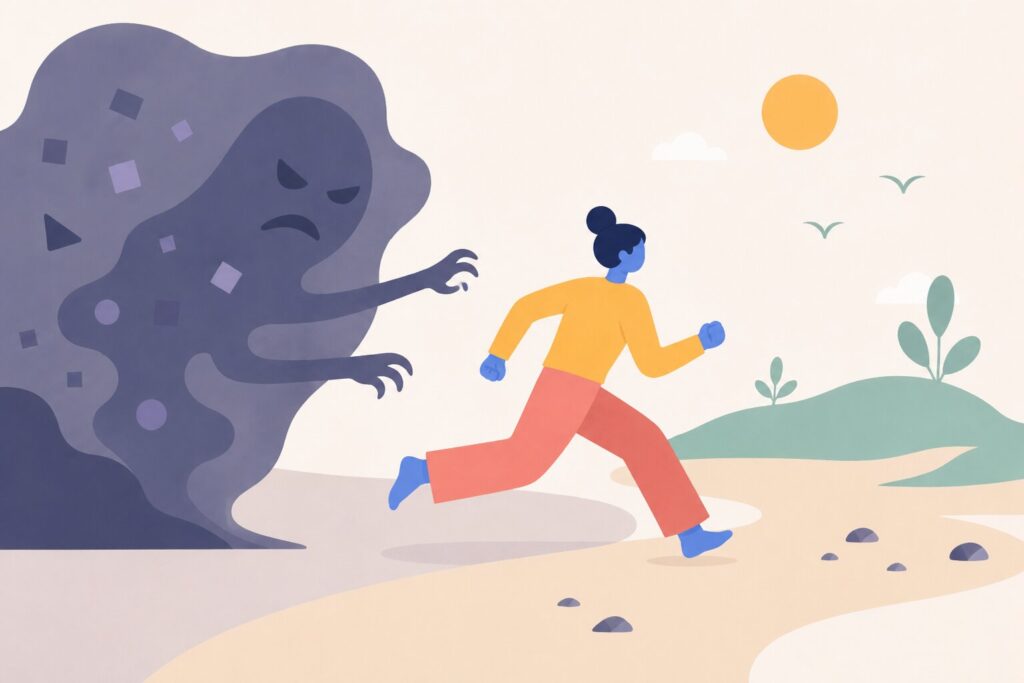
It needn’t be an email. It can be the call you keep putting off, the dentist’s number you don’t dial, the invitation you don’t answer because there’ll be people there you barely know. They all share one thing: the way out feels right in the moment. And with every time, the thing you’re avoiding grows a little larger.
The Relief That Teaches You
What happens here is a learning process, as plain as the one every habit forms by.
When you do something and afterwards something unpleasant immediately disappears, your brain learns that the deed paid off. Specialists call it negative reinforcement, and it’s stronger than any good intention. You click the email away, the tension drops, and in that moment your brain has drawn a lesson: clicking away was right. The relief is the reward, and it comes at once, which is what makes it so effective.
The problem is what comes bundled into that lesson. Relief takes for granted that a danger was there beforehand, otherwise there’d be nothing for it to free you from. So every act of avoidance writes two sentences into your memory at once: avoiding helps, and the thing was dangerous. The fear grows on the very movement meant to keep it small.
And because the relief returns every time, the berth you give the thing widens over time. First it’s the one email. Then you open your inbox less often at all. Then a faint unease already sits on the act of checking your mail. That’s how avoidance spreads, and what began as a single point becomes a territory you steer clear of.
Why the Fear Doesn’t Have to Go Away
For a long time people thought fear had to be released like pressure from a boiler. You expose yourself to the feared thing, stay with it long enough for the fear to subside on its own, and that subsiding is the cure. Michelle Craske, who has researched anxiety at the University of California for decades, has shown that this picture misleads.
In her studies, the amount by which fear dropped during a confrontation said little about how someone was doing weeks later. Some, whose fear had fallen sharply in the session, had it back soon after. Others, whose fear had stayed high, did best in the long run. The subsiding itself wasn’t the active ingredient.
What actually works is a new entry beside the old one. The original link, this thing is dangerous, doesn’t disappear. It gets a counterpart: I was in this situation, the thing I feared didn’t happen, and I stood the fear. The clearer the gap between what you expected and what occurred, the stronger this second entry. That’s why it doesn’t matter if the fear stays high during the thing. What matters is that you have the experience avoidance kept from you for years.
That turns the goal around. It isn’t about becoming calm. It’s about learning that you manage even when you aren’t.
The Little Safety Net That Ruins It All
Between open avoidance and really going in lies a third option, more insidious than avoidance itself, because it looks like courage.
The psychologist Paul Salkovskis described it as safety behaviour. You go to the party, but you stand in the corner and clutch a glass the whole time so you look occupied. You give the talk, but you read it word for word so that nothing can possibly go wrong. You drive across the bridge, but only with someone sitting beside you. You went, and still you come away with nothing.
Because if nothing bad happens afterwards, your brain credits it to the glass, the read-out page, the person beside you. Not to you. The catastrophe stayed away because you’d strung up the net, that’s the lesson, and the real question, whether it would have gone fine without one, stays open. Salkovskis was able to show that people who face something with such aids learn less from it afterwards than those who do it without. The net takes from the experience exactly what it was supposed to prove.
Why Broad Beats Deep
One detail from Craske’s research is surprisingly useful for everyday life. In an experiment with people afraid of spiders, one group was made to look at the same spider again and again until the fear eased. The other group was confronted with changing spiders, different sizes, different speeds, in random order, without regard to the level of fear.
During the exercise the second group coped worse, their fear stayed higher. But weeks later, when it counted, their fear had returned far less often. Someone who has only learned that one particular spider is harmless stands before the next one back at the start. Someone who has learned to cope with all sorts of spiders carries off something sturdier. Translated to your own life: don’t run the one feared situation twenty times over, tap the fear at many different points.
Where Self-Help Ends
Up to here this has been about the everyday avoidance almost everyone knows, where you can do something yourself. An anxiety disorder is another matter. When fear governs a large part of your day, when you’ve given up whole areas of your life, when panic overtakes you or the worry no longer stops, that’s no case for more self-conquest but one for professional support. Exposure is an effective, well-researched treatment, but with more serious anxiety it belongs in trained hands that know how to size the steps. That takes nothing away. It’s the same difference as between a few squats and rehab after surgery.
An exercise for the coming week: The Test Instead of the Escape
Take a single thing you’re currently avoiding that’s small enough to approach without help. The email left lying, the postponed call, the question you’d have to ask someone.
Before you go at it, write in one sentence what exactly you fear. Not vaguely, but concretely: what will happen, and how bad will it be? This sentence matters, because it’s the prediction you’ll be able to check something against in a moment.
Then go at the thing, and without a net. Without the glass in your hand, without the pre-worded emergency exit, without the person you usually hide behind. It isn’t about feeling good while you do it. Reckon with the tension rising, that’s no sign it’s going wrong.
Afterwards take the slip of paper again and compare. What had you feared, and what actually happened? In the vast majority of cases a gap opens between the two, and that gap is the real thing. It’s the second entry beside the old one, the new sentence in your memory. The more often you write it, at the more varied points, the more what your brain reaches for by default begins to shift.
Which thing are you avoiding right now, and what exactly do you believe would happen if you stopped?