Listen to the AI-generated audio version of this article. (Beta)
It usually happens in the quiet moments. In the shower. Doing the dishes. On the way to the train. Suddenly there’s this lingering thought about something that happened hours ago — something a friend said, a message from your sister, a brief look in a meeting. You knew yourself it wasn’t meant that way. And still, it got under your skin somehow, even if you can’t quite say why.
And if you’re honest: you couldn’t name it if anyone asked. You only know that something isn’t right.
That’s more surprising than it sounds. We spend the whole day with our feelings — after all, we carry them around with us wherever we go. But the question of what we’re actually feeling right now leaves most of us at a loss. We know a thousand words for the devices we use every day. For what’s going on inside us, “good” or “bad” usually has to do.
What we casually call “strong feelings” is often just another way of saying: I don’t understand what’s happening right now.
The feeling beneath the feeling
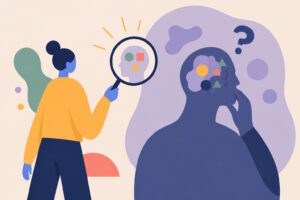
There’s an observation from psychotherapeutic practice that can be unsettling at first: what people feel on the surface is often not what they’re actually feeling.
Someone has been angry for days — at their partner, at a colleague, at their own brother. When they slow down a little, hurt appears beneath the anger, sometimes invisible for weeks. Another person describes a leaden exhaustion that no amount of sleep can fix. When the exhaustion loosens its grip, grief is sitting underneath it. Others talk about being constantly irritated, and only gradually notice the quiet anxiety pulsing beneath it — something they’ve refused to acknowledge for months.
Psychologists have a term for this: primary and secondary emotions. The primary feeling is your system’s direct response to what has happened. The secondary feeling is the response to the fact that the primary feeling isn’t allowed to be there — because it would be too vulnerable, too inappropriate, too childlike, or simply too painful.
Anger at the colleague who passed you over in front of everyone looks like the real feeling. But often it’s a shield. Underneath sits something softer: I’m hurt. I’d hoped to be seen, and I wasn’t. Anger is easier to carry than hurt. It gives you something to do. Hurt would, at first, just leave you quiet.
This mechanism isn’t pathological. In the moment, it helps. But it has a price: as long as you only feel the secondary emotion, you don’t get to the information the primary one would carry. You pick a fight with the colleague when what you actually wanted was recognition. You withdraw when what you actually needed was closeness. That’s exhausting — for you and for the people around you.
So the next time something stays with you longer than it should, the most useful question isn’t “what should I do?” but a different one:
What would I be feeling right now if this feeling weren’t here?
The answer doesn’t always come right away. Sometimes it takes a walk or a night’s sleep. But it’s usually closer to what’s really going on.
What’s actually happening inside you
One of the most interesting researchers in this field is the American psychologist Lisa Feldman Barrett, professor at Northeastern University in Boston. For more than twenty years, Barrett has studied how emotions arise in the brain — and she has come to a conclusion that contradicts most of what we’ve been taught about feelings.
We’ve all learned that emotions somehow appear in us. Fear, joy, anger — fixed states triggered by certain stimuli. Barrett disagrees. In her book How Emotions Are Made (2017), she argues that emotions are not universal, hard-wired reactions but constructions of the brain. The brain perceives bodily signals — a racing heart, tension, fatigue — and decides, based on past experience, what those signals mean right now.
That sounds abstract at first. It becomes concrete when you consider what it implies.
Imagine you’re about to give a presentation. Your heart beats faster, your hands get clammy, there’s a flutter in your stomach. You call it fear. But it could just as easily be excitement — the physical signals, as studies have shown, are largely identical. What you make of them depends on the template your brain reaches for.
Harvard psychologist Alison Wood Brooks tested this principle in a series of experiments in 2014. She had participants sing karaoke, solve math problems under time pressure, and give speeches — all situations that typically trigger nervousness. One group was told to say to themselves before the performance, “I am anxious.” The other group: “I am excited.” The result was consistent: the second group performed significantly better. Voice-analysis software showed the karaoke singers improved their performance by 17 percent. The speeches were rated more persuasive by independent observers.
The participants weren’t fooling themselves. They were interpreting the same bodily signals differently — and that changed what they did.
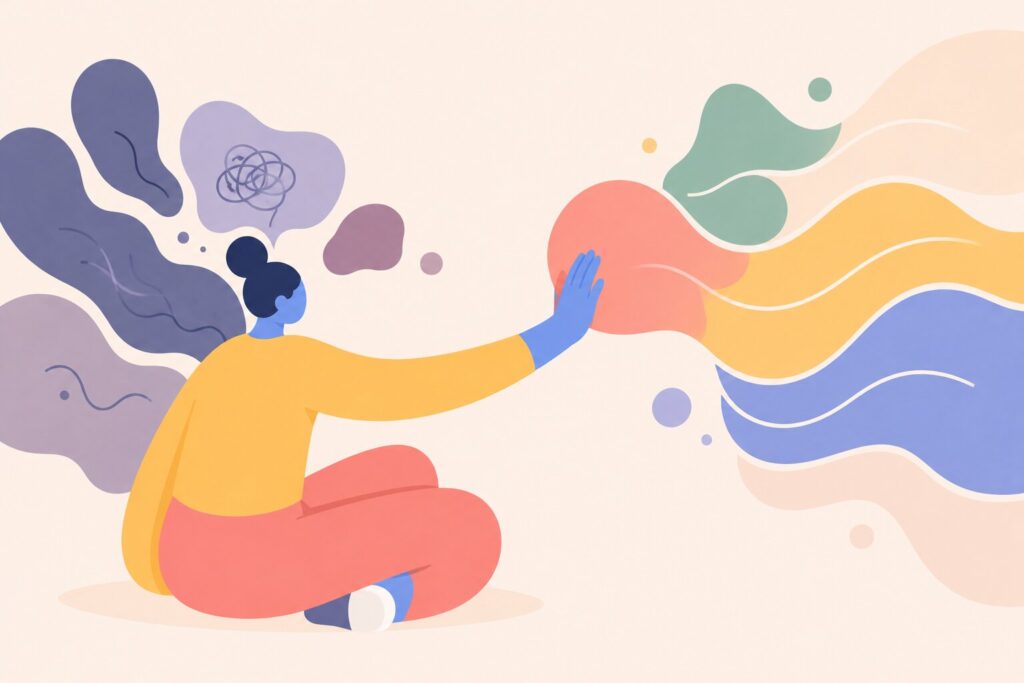
Barrett calls this phenomenon emotional granularity: the ability to distinguish between subtle differences in your own experience. If “bad” is all you’ve got, then disappointment, shame, exhaustion, and grief all blur into one grey cloud. If you can tell those states apart, you don’t just experience them more clearly — you also regulate them differently. Research from Barrett’s lab and from Todd Kashdan’s group at George Mason University shows that people with higher granularity are less likely to turn to alcohol when stressed, less likely to react aggressively, and recover faster from negative moods.
The conclusion is more sobering and more radical than the usual self-help literature suggests: you don’t need to “feel more” or “be in touch with yourself.” You need to learn to tell things apart.
Why we feel at all
There’s a second question that rarely gets asked: what’s the point? Why did such a complex emotional apparatus evolve in the first place?
The answer comes from evolutionary anthropology and has to do with the fact that humans are an extremely social species. Primatologist Sarah Blaffer Hrdy has shown across several works that human infant development — unlike that of most other primates — depends on a network of caregivers, not just the mother. This “cooperative breeding” demands something specific from the brain: the ability to constantly read the intentions, moods, and needs of others.
This explains why we react so sensitively to social signals. A small remark, a face that briefly contorts, a missing “hello” — our brain registers these things with the kind of attention you’d expect when survival is on the line. It has to. For thousands of years, our survival depended on staying accepted within the group.
The problem is that this system was not built for 2026. It reacts to a curt email with the same intensity it would have reacted, twelve thousand years ago, to a disapproving glance from the tribal elder. UCLA researchers Naomi Eisenberger and Matthew Lieberman have shown with functional brain imaging that social rejection activates similar areas as physical pain. This isn’t a malfunction. It’s a feature that kept us alive.
Once you understand this, you look at your own sensitivity differently. It’s not a defect. It’s a highly sensitive instrument working in a world it was never designed for.
What feelings want to tell you
In older psychological literature, emotions were often treated as something that had to be managed. They were considered disturbances to be kept in check by calm reason.
More recent research sees things differently. Emotions, according to the consensus in contemporary affect psychology, are not problems to be solved. They are highly concentrated information. Every feeling carries a specific message — and those who can decode the message arrive at a good response faster than those who simply try to get rid of the feeling.
What feelings tell you can be roughly translated.
Anger signals that a boundary has been crossed. Something that matters to you has been violated — your dignity, your time, your values, or what you believe to be right. The useful question isn’t “how do I get rid of the anger?” but “which boundary was touched, and what would it actually protect?”
Sadness points to a loss. It doesn’t have to be a dramatic one. An expectation that didn’t come true is a loss. So is a day that turned out differently than you’d hoped. Sadness asks: what was important to me that I’m not getting right now?
Fear signals a threat. If it’s concrete, the message is clear. If it’s diffuse, it’s worth looking at what’s at stake in the background — usually an image of yourself, a kind of recognition, a sense of safety you depend on without quite realising it.
Shame is about belonging. It arises when you fear something might exclude you from a group you want to belong to. It’s one of the most social of all emotions — and one of the most common reasons people contort themselves without noticing.
Guilt, by contrast, is more intimate. It arises when you yourself have violated a value that matters to you. Shame says: I’m not okay. Guilt says: I did something that wasn’t okay. The distinction matters in daily life because the two call for different responses — guilt can often be repaired, shame cannot.
These translations aren’t rigid rules. But they’re a surprisingly reliable compass. They change how you respond to the next difficult feeling. Instead of asking how to get rid of it, you ask what it’s trying to tell you. The moment you understand it as a message, it loses some of its urgency. It no longer has to get louder to be heard.
An exercise: The way inward
If you want to start, don’t start with grand intentions. A single practice, two or three times a week, is enough.
Find a moment when something is bothering you that was really “nothing big” — a remark still lingering, an irritation that won’t go away, a tiredness that’s been there too long. Then work your way down in four steps.
First, ask yourself what concretely is on your mind. Don’t analyse, just name it: what was it, what was said, what happened.
In the second step, the feeling on the surface. Anger, irritation, exhaustion, withdrawal — stay with one word that really fits, even if it sounds crude at first.
Then the most important step. Ask yourself: What would I be feeling right now if this feeling weren’t here? This question usually opens up something else. Beneath anger often sits hurt. Beneath exhaustion, grief or resignation. Beneath irritation, a quiet fear that something isn’t going the way you need it to. Take the first thing that comes — even if it seems inappropriate at first.
And finally: what information is this deeper feeling bringing you? A boundary that was crossed? A loss you didn’t want to admit to? A need that isn’t being met right now?
That’s it. No journaling, no app, no plan.
What you do with the answer is a different question. Most of the time, it’s enough just to know it. Much of what weighs on us weighs on us because we can’t put a name to it. Once the name is there, it loses some of its power.
References
Salovey, P. & Mayer, J. D. (1990). Emotional intelligence. Imagination, Cognition and Personality, 9(3), 185–211.
Goleman, D. (1995). Emotional Intelligence: Why It Can Matter More Than IQ. Bantam.
Barrett, L. F. (2017). How Emotions Are Made: The Secret Life of the Brain. Houghton Mifflin Harcourt.
Brooks, A. W. (2014). Get excited: Reappraising pre-performance anxiety as excitement. Journal of Experimental Psychology: General, 143(3), 1144–1158.
Kashdan, T. B., Barrett, L. F. & McKnight, P. E. (2015). Unpacking emotion differentiation: Transforming unpleasant experience by perceiving distinctions in negativity. Current Directions in Psychological Science, 24(1), 10–16.
Hrdy, S. B. (2009). Mothers and Others: The Evolutionary Origins of Mutual Understanding. Harvard University Press.
Eisenberger, N. I., Lieberman, M. D. & Williams, K. D. (2003). Does rejection hurt? An fMRI study of social exclusion. Science, 302(5643), 290–292.
Gross, J. J. (2015). Emotion regulation: Current status and future prospects. Psychological Inquiry, 26(1), 1–26.