Listen to the AI-generated audio version of this article. (Beta)
How We Psychologically Process Collective Uncertainty
When was the last time you truly felt safe? Not in an organizational sense of “the numbers are fine” or “the project is on track,” but in a deeper, inner way — grounded, steady, quietly confident.
Many people today are not facing a single storm. They are living in a climate of constant turbulence. Economic volatility, technological disruption, geopolitical tension, organizational transformation — uncertainty is no longer an exception. It has become background noise.
And that changes us.
When the Nervous System Receives No “All Clear”
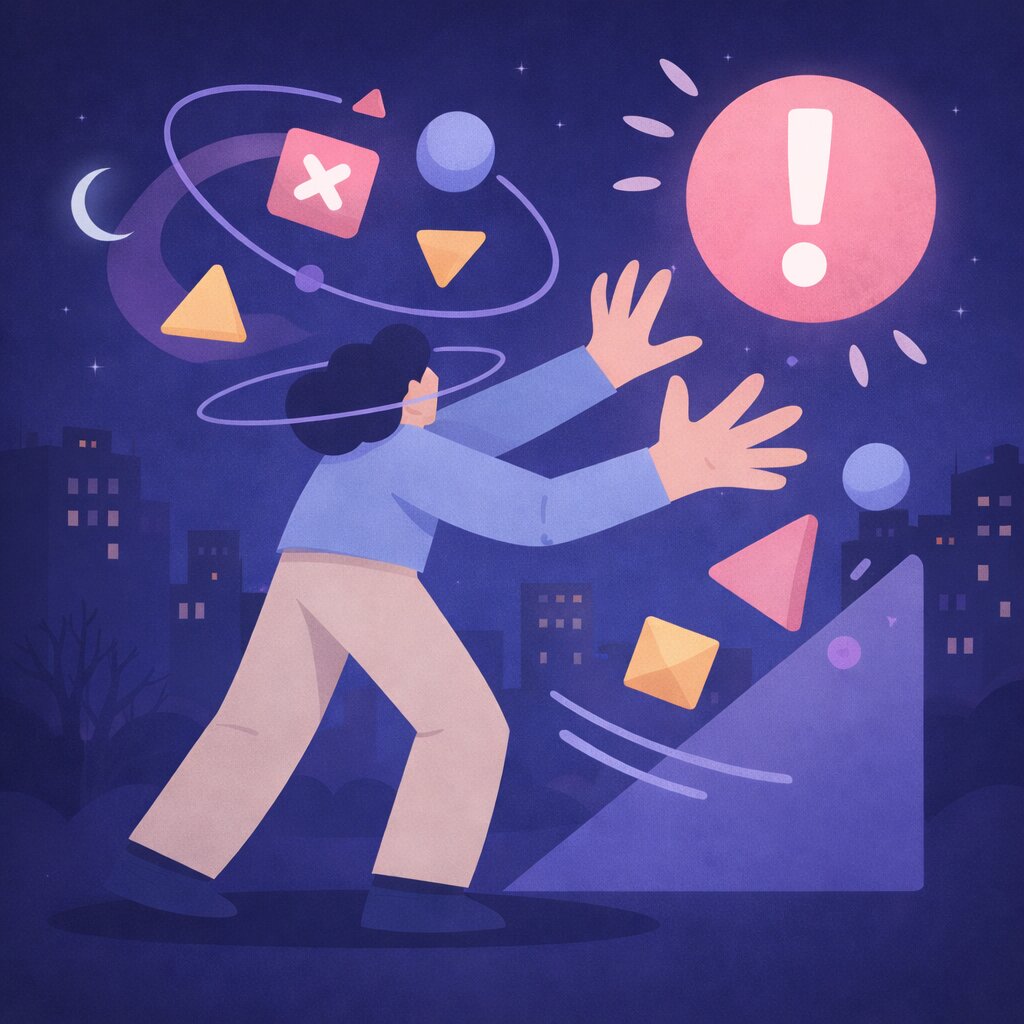
Our brain does not distinguish between a threatening headline and immediate physical danger. It reacts to uncertainty with activation. The amygdala sounds the alarm, stress hormones are released, attention narrows. In acute crises, this is adaptive. It mobilizes energy and sharpens focus.
But the human system is not designed for permanent alertness.
When no clear “all safe” signal follows, stress becomes chronic. This often manifests subtly rather than dramatically: irritability, inner restlessness, sleep disturbances, difficulty concentrating, emotional numbness. Many describe it as “functioning, but not fully present.”
This is not weakness. It is biology.
Recovery is not a luxury — it is a neurophysiological necessity. Without deliberate regulation, the nervous system remains in alarm mode, even when no immediate threat exists.
Real Uncertainty — or Constant Exposure?
Another factor intensifies the sense of instability: continuous information flow. Push notifications, social media, real-time analysis. The brain is rarely granted pauses between problem signals.
A psychologically relevant distinction emerges:
How much uncertainty directly affects my daily reality — and how much is amplified by constant exposure?
Research in attention and risk perception shows that negative information captures cognitive resources more strongly than neutral or positive input. It skews our perception of danger. The world can feel more threatening than our immediate lived experience actually is.
Intentional information hygiene becomes an act of mental self-care.
When Uncertainty Becomes an Identity Question
Many current shifts affect not only processes, but identity. Artificial intelligence, automation, new skill demands — they raise a quiet yet profound question:
Will I still be needed?
Professional identity is closely linked to self-worth. When roles feel unstable, more than job descriptions begin to tremble. A sense of significance may be at stake.
Here, perspective matters. Competence is not static. Adaptability, learning capacity, emotional intelligence, and creativity are gaining value. The ability to navigate uncertainty is itself becoming a core capability.
Different Generations — Different Security Needs
Generational differences add another layer. Younger employees often place strong emphasis on meaning, transparency, and psychological safety. They may react sensitively to ambiguity in values and long-term direction.
More experienced professionals may have lived through several economic cycles. Their calmness, however, is sometimes misinterpreted as indifference.
Tension arises not from incompetence, but from differing experiences of stability. Conscious dialogue about expectations and needs can significantly strengthen teams.
Why Control Matters So Deeply
Stress research consistently shows that strain alone does not cause lasting harm — perceived helplessness does.
The crucial question therefore is not: How do we eliminate uncertainty?
But rather: Where do we experience agency?
Even small areas of influence count. Clarifying priorities. Initiating conversations. Actively shaping work structures. Action reduces helplessness.
Leadership in Times of Uncertainty
Leaders face a delicate task: providing orientation without offering false certainty. Creating transparency without fueling anxiety.
Modern stability does not arise from perfect answers. It arises from posture. From clear reasoning, transparent decision-making, and honest communication about what is known — and what is not.
Psychological safety is not a soft skill. It is a performance factor.
Resilience Is Not an Individual Project
In recent years, resilience has often been framed as a personal responsibility. Individuals are encouraged to “be stronger.” But collective uncertainty requires collective responses.
Teams that openly discuss strain regulate one another. Organizations that communicate transparently reduce speculation and stress. Cultures that treat mistakes as learning opportunities increase adaptability.
Resilience is not merely a personality trait. It is relational.
From Permanent Alarm to Conscious Stabilization
Our nervous system needs counter-signals. Small experiences of control, meaning, and connection act as inner stabilizers.
This may include:
- Limiting news consumption intentionally.
- Creating digital quiet hours.
- Making progress visible — even small wins.
- Establishing regular team check-ins.
- Reflecting consciously on personal values.
Safety does not suddenly return one day. It is cultivated moment by moment.
Mini Tool: The Three-Circle Reflection
To conclude, a simple yet powerful exercise for individuals or teams:
Draw three circles.
In the innermost circle, write:
What can I directly influence?
In the middle circle:
What affects me but lies outside my direct control?
In the outer circle:
What can I consciously let go of?
This visual separation relieves the mind. It creates clarity. And it redirects energy back into the sphere of agency.
Perhaps this is the central insight of our time:
We cannot completely eliminate uncertainty. But we can learn to regulate our response — individually and collectively.
When external stability becomes fragile, inner posture, social connection, and conscious self-leadership gain importance.
And perhaps it is here that a new form of stability begins.