Listen to the AI-generated audio version of this article. (Beta)
Be honest: When was the last time you just sat there?
Without a podcast in your ears. Without scrolling through your feed while waiting for the bus. Without watching YouTube videos while brushing your teeth.
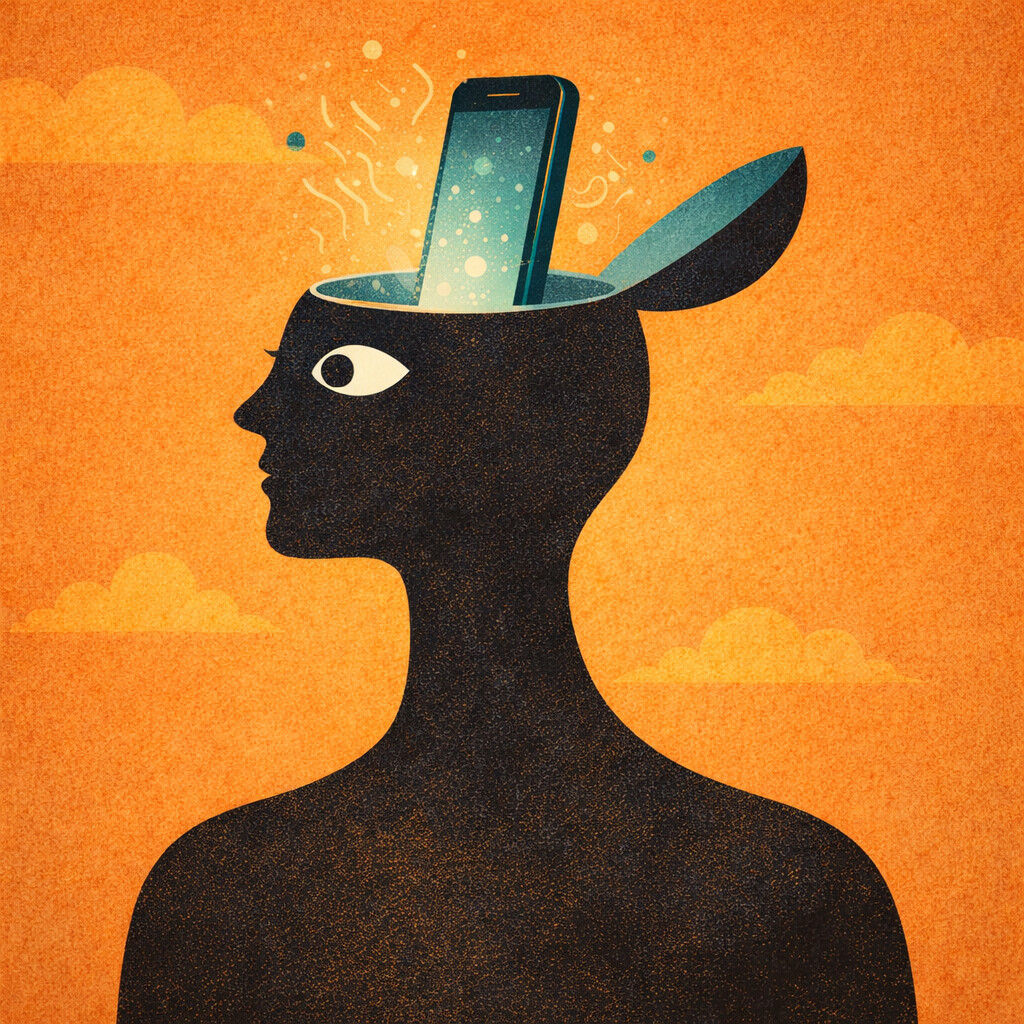
We’re living in an era where boredom seems almost extinct. The moment a 30-second gap opens up at the supermarket checkout, we reach for our smartphones. What feels like a childhood dream come true – a world without a single moment of boredom – is actually a massive problem for our cognitive performance.
We’ve forgotten how to do nothing, and in doing so, we’re robbing ourselves of one of our most important superpowers.
Boredom vs. Doing Nothing: A Small but Crucial Difference
To understand the problem, we need to distinguish between two states we often lump together.
Boredom is the uncomfortable feeling of wanting to engage in a satisfying activity but being unable to do so right now. Boredom signals us: “Find a more interesting stimulus!”
The problem is our modern response to this signal.
In the past, this feeling often led to productive idleness – a state where our thoughts can wander freely because we’re not occupied with anything else. Today, however, we immediately numb this impulse with digital junk food. We skip the phase where our brain would start mulling over things that have been simmering inside us for a long time.
What You Miss When You Fill Every Pause
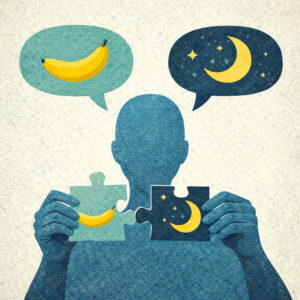
Imagine this: You’re studying vocabulary and immediately reach for your phone afterward. Or you listen to an engaging podcast during your walk and start the next one right away. In both cases, you’re robbing your brain of the chance to process what you’ve just experienced.
The Default Mode Network: When Your Brain Hits the Save Button
That this “doing nothing” is anything but idle has only been known for a few decades. Scientists call it the Default Mode Network. This network in our brain becomes active precisely when we are not.
It functions like an internal cleanup crew and a save button at the same time:
- Short breaks after learning stabilize our memories
- It processes our emotions
- It constructs our self-image and helps us understand who we are
A study by Nyberg et al. (2010) showed that subjects who took short rest periods after learning could recall what they’d learned significantly better later than those who continued immediately.
The consequence: Those who rarely do nothing risk not only having fewer good ideas but also gradually losing contact with themselves. Without these pauses, it becomes difficult to understand what gives our lives meaning.
The Conductor in Your Hippocampus Needs Silence
Imagine this: In your brain sits a memory conductor – the hippocampus. Its job is to firmly anchor information in memory.
Researchers watched subjects learning in brain scanners. The result was clear: During rest periods after absorbing new information, the hippocampus coordinated intensely with other brain regions – like a conductor coordinating different instrumental sections.
The stronger this coordination during silence, the better participants could later recall what they’d learned.
The message: The conductor can only work when no other loud stimuli have priority. When you fill every gap with content, you’re sending the conductor home before the concert is properly sorted.
The Downward Spiral of Stimulation
Why is doing nothing still so difficult for us?
Recent research by Tam et al. (2023) reveals a paradoxical diagnosis: People in the digital age feel bored more often, even though they’re constantly being stimulated.
The secret lies in our personal stimulation set-point:
- Your brain gets used to constant dopamine hits from videos, chats, or social media
- This raises the set-point you need to feel stimulated
- Even mundane activities like taking out the trash suddenly feel unbearably empty
- You reach for your phone, raising the set-point even further
- The next phase of silence becomes even more unbearable
It’s an upward spiral in the wrong direction.
How to Reclaim the Productive Pause
The good news: You can actively counteract this. Here’s your entry plan:
For Beginners: Start Small
Week 1-2: Establish Micro-Pauses
- Two minutes after waking up: Just sit there before reaching for your phone
- At the supermarket checkout: Keep your phone in your pocket
- While brushing your teeth: Just brush your teeth
Week 3-4: Free Up Routine Activities
- Walk without headphones – consciously notice your surroundings
- Let your thoughts wander while cooking instead of listening to a podcast
- Look out the window on the train instead of scrolling
For Advanced Users: Lower the Set-Point
Create Conscious Phone-Free Zones
- Leave your smartphone at home when going to the bakery
- Be completely offline for one hour daily
- Have one digitally minimalist weekend per month
After Learning Phases: Force Breaks
- After 25 minutes of focused work: Do absolutely nothing for 5 minutes
- No immediate social media reward after completing a task
- Give the conductor time to sort the concert
The Daily Ritual
Establish a fixed “doing nothing” time of 10-15 minutes:
- Put all devices away
- Sit comfortably or walk slowly
- Let thoughts come and go without judging them
- Endure the silence – it gets easier
The Difference You’ll Notice
After several weeks of consistent practice, people report:
- More creative ideas that come “out of nowhere”
- Better memory retention when learning
- Clearer sense of what they really want
- Less inner restlessness and constant craving for stimulation
- Deeper understanding of themselves
Your Next Step
Instead of clicking the next video or continuing to scroll right now, try this:
Put your device away, take a deep breath, and just stare into space for two minutes.
Your brain – and your memory conductor – will thank you.
Sources and Further Information
- Alcalá et al. (2023). The default mode network and the self. (Summary of current research on the default mode network)
- Erika Nyberg et al. (2010). Resting-state connectivity and memory consolidation
- Tam et al. (2023). Boredom in the digital age