Listen to the AI-generated audio version of this article. (Beta)
Sleep is a biological paradox. An animal that sleeps cannot hunt, cannot eat, cannot reproduce. It lies defenseless, an easy target for predators. From an evolutionary perspective, sleep should have disappeared long ago – and yet almost all animals sleep, from roundworms to elephants. Even jellyfish without a brain show all the hallmarks of sleep: nighttime inactivity, delayed responses to stimuli, and a need for recovery after sleep deprivation. The upside-down jellyfish sleeps about eight hours a day – and even indulges in a midday rest.
The question is no longer whether all animals sleep. The question is: why is this risky state so fundamental that evolution has preserved it for hundreds of millions of years?
The evolutionary puzzle: why do we sleep at all?
As life evolved, organisms were constantly exposed to fluctuations in their environment: day and night, summer and winter, high tide and low tide. Species that were equally optimized for both extremes proved inefficient. Evolution found a radical solution: specialization for one time of day and inactivity during the other.
A nocturnal animal gains nothing from being awake during the day – it would only waste energy and attract enemies. Sleep became the guardian of the circadian rhythm, the biological barrier that ensures organisms remain inactive at the wrong time.
The big brown bat only needs to be awake about four hours a day, since its insect prey is active only in the evening. The rest is sleep – not out of laziness, but out of evolutionary necessity. If the bat were active during the day, it would become easy prey for birds of prey.
But sleep is more than adaptive hiding. The evolutionary pressure not to sleep is enormous. And yet sleep has been highly conserved for hundreds of millions of years – which means an even greater selective pressure must exist to preserve this behavior.
The diversity of sleep: from three hours to twenty
Sleep duration varies extremely between species – and offers insight into evolutionary priorities. African elephants sleep only three to four hours a day, while armadillos sleep more than 18 hours. Why?
The answer lies in ecology and energy balance. Large herbivores like elephants must eat almost continuously – which is directly proportional to time spent awake. They simply cannot afford long sleep.
Dolphins and whales have developed an even more radical solution: they sleep with only one half of their brain at a time, while the other remains on alert. Newborn orcas and their mothers hardly sleep for weeks if the calves are born during migration.
Animals with larger brains may need more sleep for memory consolidation. Animals exposed to more parasites spend more time sleeping – presumably to redirect energy toward immune defense.
What happens in the brain at night
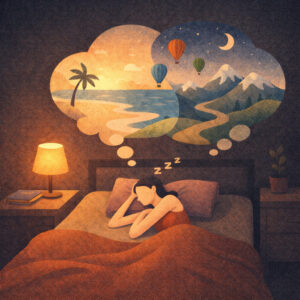
While we sleep, the brain is anything but inactive. During deep sleep, the body regenerates cells, repairs tissue, and heart rate slows. But the real work happens in REM sleep – the phase in which we dream.
This is when memories are sorted, emotions processed, and neural connections rewired. Fear-inducing experiences are emotionally softened, complex problems viewed from new perspectives. The brain is almost as active as it is when awake.
Neuroscientific studies show that sleep deprivation fundamentally alters brain activity. The amygdala – our emotional alarm center – reacts up to 60 percent more strongly to negative stimuli. At the same time, the prefrontal cortex, which regulates emotions, works far less efficiently. We become more irritable, impulsive, emotionally unstable.
Even one hour makes a difference: when people lose one hour of sleep during the spring daylight saving time change, heart attacks increase by 24 percent. In autumn, when they gain one hour, heart attacks decrease by 21 percent.
A recent study from Oregon Health & Science University shows that sleep correlates more strongly with life expectancy than nutrition, exercise, or social isolation.
When healthy people don’t sleep for days
What happens when the body no longer gets what it needs? After 24 hours, cognitive impairment corresponds to a blood alcohol level of 0.1 percent – above the legal limit. After 36 hours, mood deteriorates, inflammatory markers rise, and the immune system weakens. After 48 hours, microsleeps occur – fractions of a second in which the brain shuts down, extremely dangerous when driving. After 72 hours, hallucinations, paranoia, and emotional loss of control begin. After 96 hours, the state resembles acute psychosis: delusions, incoherent speech, tremors, cardiac arrhythmias.
In 1964, Randy Gardner stayed awake for eleven days. On the eleventh day, he was asked to count backward from 100 by sevens and stopped at 65. When asked why, he replied, “I forgot what I was doing.” Decades later, he developed severe insomnia: “About 10 years ago, I stopped sleeping. I couldn’t sleep. I lay in bed for five or six hours, maybe slept 15 minutes, and woke up again.” He himself sees it as a kind of “karmic payback” for his experiment. The body cannot compensate for sleep, only postpone it.
Why modern lifestyles sabotage sleep
Our ancestors lived by the rhythm of the sun. Daylight synchronized their internal clocks, physical labor made them tired, darkness signaled rest.
Today we live differently. Screens suppress melatonin late into the night. Artificial light tricks the brain into thinking it is daytime. We sit for hours, hardly move, and are constantly reachable. The nervous system interprets these signals as a state of alert.
Sleep deprivation disrupts hormonal balance. Leptin, ghrelin, and adiponectin – hormones that regulate appetite – become dysregulated. Lack of sleep leads to cravings for calorie-dense foods and increases the risk of type 2 diabetes by impairing glucose metabolism.
What really promotes good sleep
Sleep cannot be commanded, but it can be facilitated. The most important insight from research: sleep hygiene begins in the morning, not in the evening. Good sleep is the result of an entire day – not just the last hour.
Regularity is the strongest lever. The body runs on an internal rhythm, the circadian system. Going to bed and waking up at the same time every day – even on weekends – trains this rhythm. Irregular sleep times confuse the internal clock and lead to poorer sleep, even if total sleep duration is sufficient.
Light controls the rhythm. Daylight is the strongest time cue for the internal clock. Just ten minutes of bright morning light – ideally outdoors – helps the body understand: now it is day. In the evening, the opposite should happen: dim the lights one hour before bedtime. Even small amounts of light can disrupt melatonin production, the hormone that makes us sleepy. Blackout curtains or a sleep mask can help.
Movement makes you tired – at the right time. Physical activity reduces stress hormones and promotes deep sleep. The old rule “don’t exercise three hours before bedtime” has been disproven. New studies show that people who exercise at 8 p.m. or later fall asleep quickly and get sufficient deep sleep. What matters is individual response – some benefit from evening workouts, others do not.
The sleep environment matters. The ideal room temperature is around 18°C (64°F) – a cooler room promotes deeper sleep. Darkness is crucial, as is quiet. If necessary: earplugs or white noise machines. The bed should be used only for sleep and intimacy, not for work, eating, or watching TV. Through this association, the body learns: bed = sleep.
Caffeine and alcohol sabotage the night. Caffeine has a half-life of five to six hours – meaning a coffee at 4 p.m. can still be active at 10 p.m. Recommendation: no caffeine at least eight to ten hours before bedtime. Alcohol may make you drowsy at first but destroys sleep architecture. REM sleep is suppressed and sleep becomes fragmented. The result: you may fall asleep faster, but wake more often and feel exhausted in the morning.
Evening rituals signal: now it is rest time. The body needs a transition from day to sleep. A warm shower (around 40°C / 104°F) about twenty minutes before bed can help – it lowers core body temperature afterward and facilitates falling asleep. Screens should be turned off at least 30 minutes before bedtime – not only because of blue light, but because they emotionally activate us. An email can trigger stress, a gripping series keeps us alert.
Relaxation techniques help the nervous system. Breathing exercises, progressive muscle relaxation, or gentle stretching reduce physiological arousal. Studies show a strong link between relaxation routines and better sleep quality. For those who ruminate in the evening: write a “worry list.” Putting thoughts on paper relieves the brain and makes letting go easier.
What if sleep doesn’t come? If you can’t fall asleep after 20 minutes, get up and do something boring – read an uninteresting book, sit quietly. Actively trying to sleep creates frustration and keeps you awake. As soon as sleepiness returns: go back to bed.
Nutrition and sleep are linked. Heavy, high-fat meals shortly before bedtime strain digestion and disrupt sleep. Recommendation: the last large meal four hours before bedtime. Highly glycemic carbohydrates can also impair sleep quality – they increase nighttime awakenings and reduce deep sleep.
Individualization is crucial. Not every recommendation works equally well for everyone. Some people are more sensitive to caffeine, others need absolute darkness, and others benefit from a short nap. Sleep hygiene is not a rigid rulebook – it is a toolbox from which everyone should choose what works best.
The key insight: good sleep does not arise from willpower, but from creating the right conditions. If you allow your body to sleep, it will sleep.
Conclusion: sleep is non-negotiable
Evolution has preserved sleep for hundreds of millions of years, even though it is risky, time-consuming, and seemingly unproductive. That alone shows: sleep is indispensable.
Chronic sleep deprivation leads to attention deficits, emotional instability, metabolic and cardiovascular disorders, immune weakness – and in extreme cases, death.
The night is not lost time. It is the half of life that makes us fit for the other.
Sources
Scientific studies
- Irish et al. (2015). The Role of Sleep Hygiene in Promoting Public Health: A Review of Empirical Evidence. Sleep Medicine Reviews, PMC4400203
- Chow, C. M. (2022). Sleep Hygiene Practices: Where to Now? MDPI Public Health and Preventive Medicine
- Walker, M. & Huberman, A. (2024). Guest Series: Protocols to Improve Your Sleep. Huberman Lab Podcast
- Peach et al. (2024). Sleep hygiene efficacy on quality of sleep and mental ability among insomniac patients. Journal of Family Medicine and Primary Care, PMC11610801
- Reynolds et al. (2024). Sleep hygiene – What do we mean? A bibliographic review. Sleep Medicine, ScienceDirect
- Reynolds et al. (2023). Healthy sleep practices for shift workers: consensus sleep hygiene guidelines using a Delphi methodology. SLEEP, Oxford Academic
Sleep deprivation research
- Gardner Sleep Deprivation Experiment (1964), Stanford University
- Effects of sleep deprivation on cognitive performance and health outcomes, various sources
Evolutionary biology of sleep
- Lesku et al. (2008). Adaptive sleep loss in polygynous pectoral sandpipers. Science
- Siegel, J. M. (2009). Sleep viewed as a state of adaptive inactivity. Nature Reviews Neuroscience
- Nath et al. (2017). The jellyfish Cassiopea exhibits a sleep-like state. Current Biology
Health impacts
- Janszky & Ljung (2008). Shifts to and from Daylight Saving Time and Incidence of Myocardial Infarction. New England Journal of Medicine
- Oregon Health & Science University (2024). Sleep correlates with life expectancy study