Listen to the AI-generated audio version of this article. (Beta)
Jonas remembers exactly the moment his body stopped being something he could take for granted.
There was no accident, no collapse, no shock.
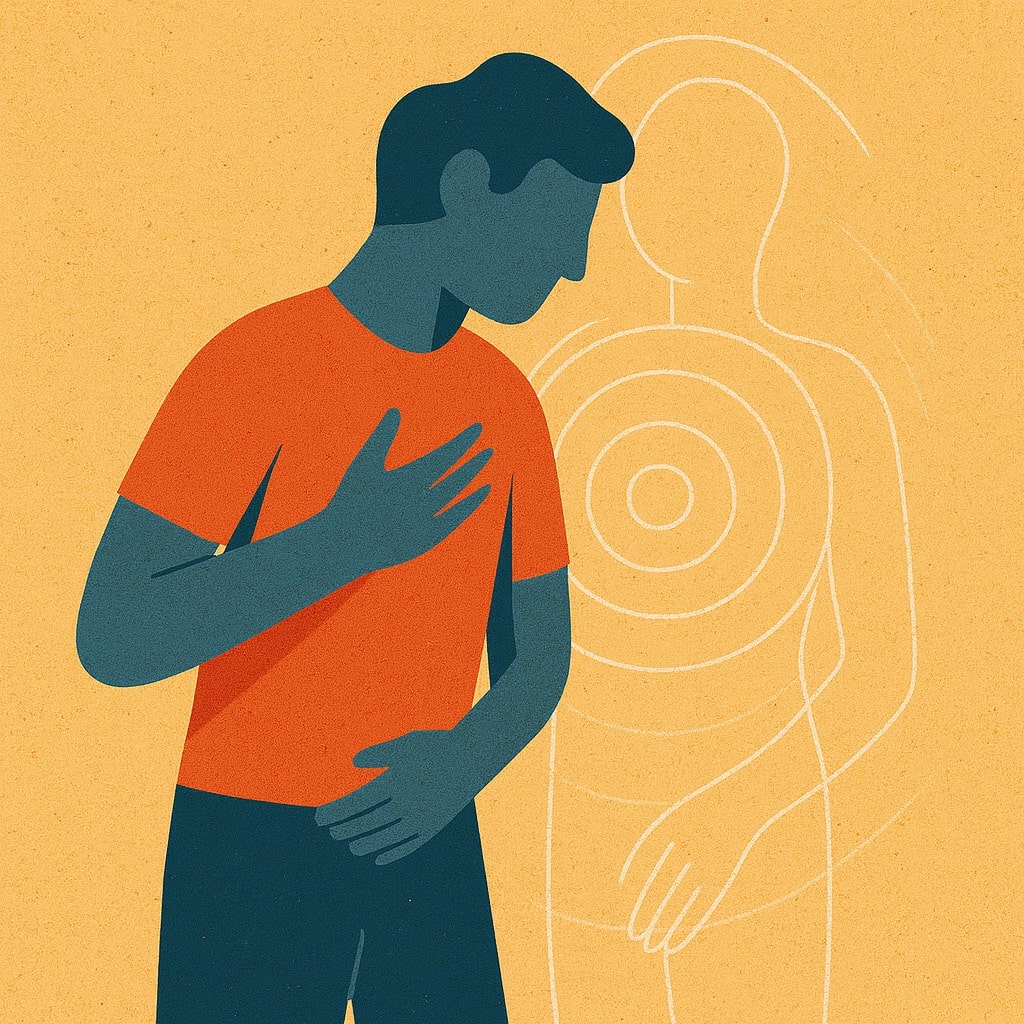
Just a racing heartbeat on an ordinary Tuesday morning.
He was sitting at his desk, drinking coffee, answering emails. Then that brief stumble. One beat too many. Then another.
Jonas paused. Listened. Waited.
For a moment there was something like alarm. No thought—just reaction.
Then: nothing.
No pain. No collapse. No catastrophe.
And yet something lingered.
Not fear—because nothing had happened.
But uncertainty.
What Jonas didn’t know was that this moment marked the beginning of a learning process in his nervous system, not a physical problem.
When the Body Is Faster Than the Mind
Anxiety does not start where we think.
It starts where the brain evaluates before conscious reasoning can catch up.
At the center of this process is the amygdala—a structure that rapidly scans incoming information for potential threat. When something is assessed as dangerous, it activates the autonomic nervous system. Stress hormones such as adrenaline and noradrenaline are released, heart rate and breathing increase, muscles tense.
This pathway is fast. Very fast.
It bypasses conscious thought.
The prefrontal cortex, responsible for reasoning and contextual evaluation, comes online later. This means the body often reacts before we know why.
In real danger, this is life-saving.
In Jonas’s case, the system reacted to something that wasn’t happening in the outside world.
Fear, Anxiety, and Panic—Not Categories, but a Continuum
When a car suddenly brakes or someone shouts at us, the body reacts immediately. Activation is high but focused. Once the situation passes, the system settles. This response is fear: concrete, brief, and functional.
Jonas experienced something different.
His body reacted without an external threat.
What followed was a sustained state of internal alertness. Thoughts like What was that? or What if it happens again? kept the nervous system activated. This is anxiety—not a response to danger, but to possibility.
Sometimes this anxiety intensifies to the point where it tips over.
The heart races, breathing becomes shallow, the body feels unfamiliar. A thought follows instantly: This is dangerous.
In that moment, anxiety becomes frightened of itself. This is panic.
From a neurobiological perspective, panic is not a separate system but an escalation of the same circuitry. The amygdala continues firing, stress hormones rise, while the prefrontal cortex becomes less effective. Control narrows, perception tightens.
What matters is this: even panic is self-limiting.
The body cannot sustain this level of activation indefinitely.
When Attention Sharpens the Alarm
After that first moment, Jonas began monitoring himself.
Not intentionally—almost automatically.
He noticed his heartbeat more often. Paid closer attention to his breathing. Scanned for tension.
Each sensation arrived with a question attached.
Is this normal?
Should I feel this?
What if it gets worse?
Neurobiologically, this makes sense. Attention strengthens neural pathways. The more often a signal is checked, the more relevant it becomes to the brain. The amygdala learns: This matters.
The threshold for alarm drops.
This process is known as anxiety sensitivity—the fear of one’s own bodily reactions. Over time, the body itself becomes the trigger.
Why Understanding Is Not Enough
At some point, Jonas understood that his heart was healthy.
He knew anxiety could cause physical symptoms.
And yet his body kept reacting.
This is not a contradiction. It’s neurobiology.
Anxiety learns through experience, not insight.
The amygdala does not respond to logic, but to repeated patterns. As long as bodily alarm is followed by avoidance or reassurance, the system stays active.
The problem is not that we don’t understand anxiety.
The problem is that anxiety learns faster than reasoning.
When Caution Becomes a Trap
The thoughts that follow sound reasonable.
Better not exercise today.
Maybe skip the coffee.
Check the pulse—just in case.
Leave early.
These behaviors reduce activation in the short term. Stress hormones drop. The body calms. It feels like relief.
But learning happens here.
The brain does not store I was safe.
It stores This action saved me.
In cognitive-behavioral therapy, these actions are called safety behaviors. Neurobiologically, they prevent extinction learning—the unlearning of the fear response. The alarm is never disproven.
Fear of Fear
Over time, Jonas became less afraid of individual symptoms and more afraid of their return.
What if it happens again?
What if I lose control?
This anticipatory anxiety is often more distressing than the original reaction. It keeps the nervous system in a state of readiness. Every sensation becomes a potential trigger.
Anxiety becomes its own stressor.
When Control Exhausts
Jonas’s life grew smaller.
Not dramatically—but noticeably.
He avoided exertion. Declined plans. Waited.
And remained tense.
The turning point did not come from insight, but from exhaustion.
So much control—and still no safety.
That was when he allowed something different.
What the Body Needs to Learn
Jonas started running again.
Not calm. Not brave. But willing.
His heart rate increased. Breathing quickened. Thoughts appeared.
And he did nothing.
No checking. No stopping. No negotiating.
In behavioral therapy this is called exposure. When it targets bodily sensations, it’s known as interoceptive exposure. Neurobiologically, it enables what was missing before: new learning.
The amygdala experiences that activation is not dangerous.
The prefrontal cortex can reengage.
The stress system rises—and falls.
Anxiety increases. And then decreases.
Always.
What Helps in Daily Life
Lack of sleep, caffeine, and physical inactivity do not cause anxiety, but they increase baseline nervous system activation. Cortisol levels remain elevated, lowering the threshold for alarm.
Regular movement, adequate sleep, and mindful use of stimulants reduce this baseline tension. They do not replace experience—but they make it easier.
What Remains
Fear protects us when danger is real.
Anxiety prepares us for possibility.
Panic is an intense but temporary escalation of the same system.
What traps people is not the body.
It is the attempt to control every reaction.
Anxiety does not lose its power when it disappears.
It loses its power when the nervous system relearns that it is safe.
Sometimes that learning takes time.
And sometimes, it takes support.
Scientific background and references
Neurobiology of fear, anxiety, and panic
LeDoux, J. E. (2000). Emotion circuits in the brain. Annual Review of Neuroscience, 23, 155–184.
Foundational paper on the role of the amygdala and fast threat-processing pathways.
LeDoux, J. E., & Pine, D. S. (2016). Using neuroscience to help understand fear and anxiety. American Journal of Psychiatry, 173(11), 1083–1093.
Clear neurobiological distinction between fear (acute threat) and anxiety (anticipatory threat).
Mobbs, D., et al. (2009). From threat to fear: The neural organization of defensive fear systems. Journal of Neuroscience, 29(39), 12236–12243.
Neural escalation processes relevant to panic responses.
Cognitive-behavioral models
Clark, D. M. (1986). A cognitive approach to panic. Behaviour Research and Therapy, 24(4), 461–470.
Classic CBT model explaining panic as a result of catastrophic misinterpretation of bodily sensations.
Salkovskis, P. M. (1991). The importance of behaviour in the maintenance of anxiety and panic. Behaviour Research and Therapy.
Introduces safety behaviors as a key maintaining factor in anxiety disorders.
Barlow, D. H. (2002). Anxiety and its disorders: The nature and treatment of anxiety and panic. Guilford Press.
Comprehensive CBT framework including fear of fear and panic.
Anxiety sensitivity and fear of bodily sensations
Reiss, S., & McNally, R. J. (1985). Expectancy model of fear.
Foundational work on anxiety sensitivity.
McNally, R. J. (2002). Anxiety sensitivity and panic disorder. Biological Psychiatry, 52(10), 938–946.
Empirical evidence linking anxiety sensitivity to panic symptoms.
Exposure and learning mechanisms
Boswell, J. F., et al. (2013). Anxiety sensitivity and interoceptive exposure. Journal of Anxiety Disorders, 27(6), 543–551.
Evidence for interoceptive exposure in reducing fear of bodily sensations.
Craske, M. G., et al. (2014). Maximizing exposure therapy: An inhibitory learning approach. Behaviour Research and Therapy, 58, 10–23.
Modern learning-based explanation of why exposure works.
Bouton, M. E. (2004). Context and behavioral processes in extinction. Learning & Memory, 11(5), 485–494.
Key paper on extinction learning and relapse mechanisms.
Stress systems and regulation
McEwen, B. S. (2007). Physiology and neurobiology of stress and adaptation. Physiological Reviews, 87(3), 873–904.
Overview of stress hormones, cortisol, and allostatic load.
Arnsten, A. F. T. (2009). Stress signalling pathways that impair prefrontal cortex structure and function. Nature Reviews Neuroscience, 10, 410–422.
Explains reduced cognitive control under stress.
Lifestyle factors: exercise and caffeine
Jayakody, K., et al. (2014). Exercise for anxiety disorders: A systematic review. Depression and Anxiety, 31(9), 733–744.
Evidence for the anxiolytic effects of physical activity.
Stonerock, G. L., et al. (2015). Exercise as treatment for anxiety. Current Sports Medicine Reports, 14(4), 261–268.
Liu, Y., et al. (2024). Caffeine intake and risk of anxiety: A meta-analysis. Frontiers in Psychiatry.
Association between higher caffeine intake and increased anxiety symptoms.